- 25 Sep , 2026
- Blog
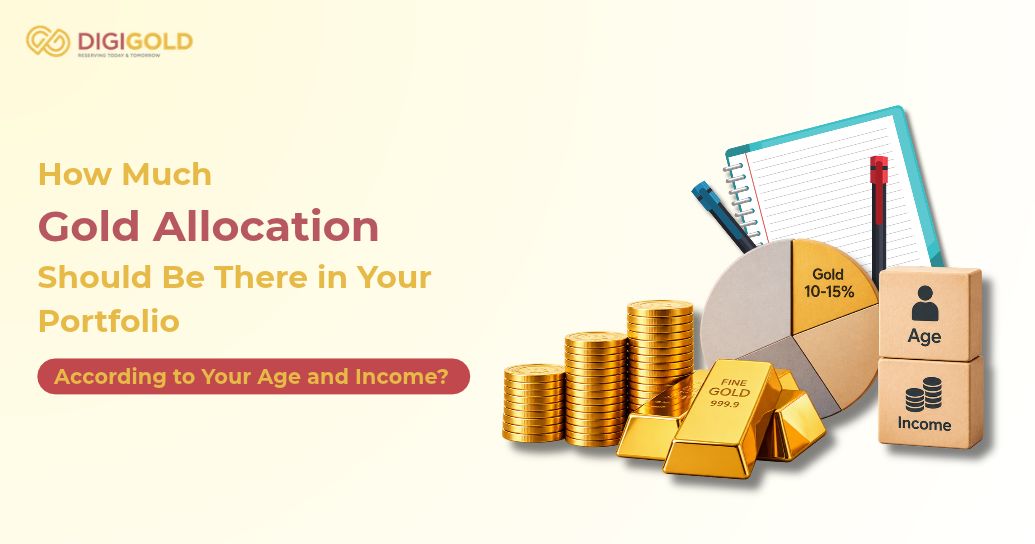
How Much Gold Allocation Should Be There in Your Portfolio According to Your Age and Income?
People usually say, “Always keep some gold in your portfolio.” But how much gold is actually enough?
Should a 25-year-old earning ₹40,000 a month hold the same amount of gold as a 55-year-old planning retirement? Probably not.
There isn't a one-size-fits-all approach when it comes to gold allocation. Your age, income, financial goals, risk tolerance, and even your stage of life all play a role in deciding how much gold should be there in your portfolio.
Indians have always seen gold as a safe way to invest in gold, especially during periods of inflation, economic uncertainty, or market volatility. But today's investors have more choices than buying jewellery or storing bullion at home.
Let's figure out how much gold should be in your investment portfolio and how your age and income can help determine the right target allocation.
Why should Gold still should be there in your investment portfolio?
Someone is buying mutual funds. Someone is investing in stocks. Then there are people who prefer FDs.
Yet, almost everyone still wants to hold gold. That's because gold occupies a unique place as an asset class. Unlike assets like gold-linked securities or equity investments, gold's value often behaves differently during difficult market conditions.
Gold has historically acted as a hedge during periods of inflation and financial stress. When markets become volatile, many investors look toward precious metal holdings for protection.
This doesn't mean gold always delivers better returns than equities. But a diversified portfolio isn't built by chasing only the highest returns over time. It's built by balancing growth and stability. That's where gold investments can contribute.
Many financial advisors and market experts recommend keeping a portion of your total portfolio in gold because it helps diversify risk and improve risk-adjusted outcomes over the long term.
What are the factors that tell how much should you hold gold?
Before asking "how much to invest in gold," answer the following questions.
- What are my financial goals?
- How stable is my income?
- How much risk can I handle?
- Do I have an emergency fund covering several months of expenses?
- Am I investing to build wealth or preserve it?
Your answers matter more than any generic benchmark.
A young professional with a high risk tolerance and a long time horizon may allocate less to gold and more to growth-oriented assets. Someone approaching retirement may prefer a larger gold allocation to reduce exposure to sudden market downturns.
Your ideal portfolio should reflect your life, not someone else's.
How much gold allocation should be there as per your age?
While there are exceptions, age offers a useful starting point.

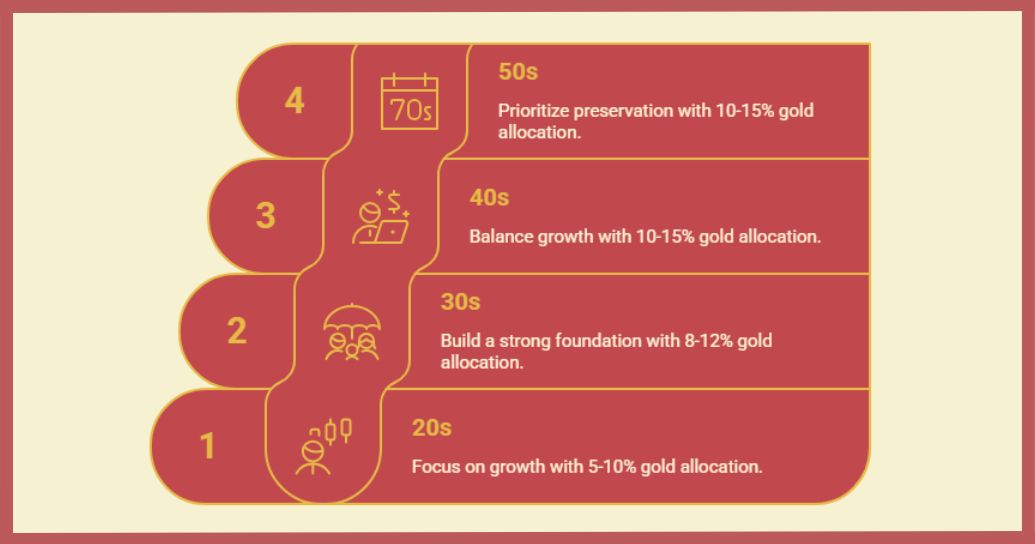
Focus on growth and keep investing in gold in your 20s
If you're in your twenties, your biggest advantage is time. You can recover from market corrections. You can ride out volatility. You can take calculated risks.
For investors in this age group, a gold allocation of around 5% to 10% of the investment portfolio is sufficient.
The majority of your money can be directed toward equity investments, retirement accounts, and other growth-focused opportunities.
A small gold position still makes sense because life can be unpredictable. Markets can change. Economic uncertainty can show up when least expected.
Focus on building a strong financial foundation in your 30s
Your thirties are when responsibilities begin multiplying.
Home loans. Family expenses. Children's education planning.
At this stage, many investors allocate around 8% to 12% of their total investment portfolio to gold. You still have a relatively long investment horizon, but protecting accumulated wealth becomes more important than it was a decade ago.
Gold and silver can both play a role here, especially when you're aiming for a diversified portfolio that isn't entirely dependent on stocks and bonds.
Focus on balancing growth in your 40s
Most people in their forties are in their peak earning years. Income rises, but so do financial commitments. A portfolio allocation guide for this age group suggests keeping approximately 10% to 15% of gold. Because preserving wealth gradually becomes just as important as creating it.
Investors pay attention to market trends, liquidity requirements, and future retirement planning. A meaningful allocation to gold can act as a cushion when markets become volatile.
Preserving your investment is a priority in your 50s
Retirement is no longer a distant concept. Experts recommend increasing exposure toward the upper end of the range, typically between 10% and 15%, depending on individual circumstances.
This doesn't mean abandoning growth assets like stocks. It means adjusting your asset allocation to reflect changing priorities.
Gold's role becomes less about aggressive growth and more about capital preservation, stability, and protecting against sudden market conditions.
Is income equally important?
Absolutely. Age provides context, but income determines capacity.
Consider two investors who are both 35 years old.
One earns ₹50,000 per month. The other earns ₹3 lakh.
Their gold allocation percentage may be similar, but the actual amount invested will differ significantly.
Here's a simple framework.
| Monthly Income | Suggested Gold Allocation |
| Up to ₹50,000 | 5% to 8% |
| ₹50,000 - ₹1.5 Lakh | 8% to 12% |
| ₹1.5 Lakh and Above | 10% to 15% |
The key isn't deciding how much gold to own. It's deciding how much of your portfolio should reflect stability versus growth.
Higher-income individuals have greater investable assets. This allows them to maintain a stronger portfolio in gold without sacrificing growth opportunities elsewhere.
Physical Gold vs Digital Gold: Which form of precious metal should you own?
Jewellery isn't always an efficient investment strategy. Making charges, storage concerns, purity questions, and resale deductions can reduce flexibility. That's one reason many modern gold buyers are moving toward digital alternatives.
Through a trusted gold investment platform, investors can purchase pure gold without worrying about storage or security. A gold investment app also makes small, consistent purchases easier.
You don't need to save for months before buying 1 oz of gold. You can start with smaller amounts and gradually build your portfolio.
Why are investors preferring to buy digital gold online?
The investing experience has changed dramatically over the past few years. People manage banking, insurance, shopping, and investing from their phones. Naturally, gold investment has followed the same path.
When you buy digital gold online, you gain flexibility that traditional purchases don't provide.
Benefits include:
- Start investing with small amounts
- Buy according to the live spot price
- Track gold prices in real time
- Easy liquidity when needed
- Secure ownership backed by physical bullion
Platforms like DigiGold make it possible to buy digital gold online in minutes, helping investors gradually build a long-term portfolio without needing large upfront capital.
When should you increase gold allocation of your asset class?
Certain situations justify a larger gold allocation than normal.
For example:
- You're approaching retirement.
- Market volatility feels unusually high.
- You have significant exposure to equity investments.
- Economic uncertainty is affecting confidence in the financial system.
- You're looking for additional downside protection.
In these cases, investors increase their investment portfolio to gold temporarily while continuing to monitor their overall strategy. Don't take decision because the price of gold is rising. Gold prices move in cycles, just like stocks.
Mistakes that investors should avoid with gold and silver
Some people allocate too little and miss out on diversification benefits. While some become overly cautious and place too much of their portfolio into a single commodity. Neither extreme is ideal.
Another common mistake is forgetting to rebalance.
Suppose your target allocation is 10%. If gold's value rises sharply, it could become 15% of your total portfolio. Periodically reviewing and adjusting allocations helps maintain balance.
How much of your portfolio should include gold?
Experts recommend keeping between 5% and 15% of your total portfolio in gold, depending on age, income, financial goals, and risk tolerance.
The goal is to create a balanced portfolio that can navigate different market conditions with confidence. And today, doing that is easier than ever.
Whether you're investing ₹10 or ₹10,000, using a trusted gold investment platform and a reliable gold investment app allows you to gradually hold gold. Because sometimes the smartest investment decisions are about building a portfolio that can stand strong through whatever comes next.

Related Posts

- 17 Mar , 2023
- DigiBlog
Beyond Ornamentation: 7 Surprising Uses of Gold
Majority of individuals don’t know what are the uses of gold, other than jewellery & saving. Gold has several industrial applications. It is used in electronics, dentistry, medicine, and is also a popular investment option.

- 04 May , 2023
- DigiBlog
Why Should I Start Saving Money At A Young Age
Investing money at a young age can be daunting. You don’t have that income, but you wish to secure your future. What should you do?
- 20 Jan , 2025
- DigiBlog
The Beginner’s Guide to Investing in Digital Silver
Discover the ultimate beginner's guide to investing in digital silver. Learn how to buy digital silver online at live market rates and enjoy the benefits of digital silver.